

Hard Hitting Conservative Commentary by Gary M. Polland
Volume XXV Number 8 – November 12, 2026
GOP IN TEXAS SUFFERS
WORST DEFEAT IN DECADES!
Well, this was unexpected. In Texas, Republicans were not under polled, it was Democrats.
TCR was not surprised at Ken Paxton’s defeat, but this election was much more than that. Paxton, with all his baggage, his unenergetic efforts did not cause virtually complete Democratic sweep. It goes much higher in the food chain.
We have a few thoughts:
- President Trump’s low approval rating in Texas was the start.
- Divisions in the GOP hurt, as in politics you win by addition and subtraction.
- Even Senator Cornyn would not have survived this drubbing.
- Talarico ran a well-funded, disciplined campaign and had the November campaign by himself, giving him a big head start, while Cornyn and Paxton spent over $100 million bashing each other.
- The down ballot candidates, our quality judge candidates, had essentially no campaign due to the top races dominating. So, once the top ticket cratered it was over down the ballot.
- The votes didn’t differentiate between candidates. The best example, Marc Cowart running for Harris County Treasurer against Carla Wyatt, who had been in and out of the criminal justice system, rejected by the Houston Chronicle, was just a few hundred votes behind the rest of the ticket.
- Voters essentially were voting a straight Democratic ticket.
- The GOP office holders who have been around “forever” became stale and newer faces are needed.
- In other states, the quality candidates were not adequate. Sure, it’s not fair that the Democrats trash candidates were ignored basically by the mainstream leftist media. It is not good for us that the weak questionable candidates were still elected. Apparently, many voters just ignored the facts. It is our collective loss.
- We are also wondering whether the hundreds of millions spent in Texas would have been better spent in other states with good candidates like Minnesota, Ohio, Michigan, Maine and others.
- The massive negative campaigns against the top of the Democratic ticket in Texas overwhelmed any positive campaign and key issues. What happened to ideas like, the “Compact with Texas” featuring the five policy ideas that will be implemented addressing the big issues of affordability and fighting corruption. I know, the Democrats did not campaign on any definite ideas and essentially got a pass.
- It is not helpful that GOP voices, starting with the Vice-President, blames the Iran war, anti-Israel sentiment, and the economy. No poll we have seen indicates that. Is the Vice-President just catering to the small contingent of Jew haters on the far right led by Tucker Carlson (recall he endorsed radical leftist El Sayed in the Michigan Senate race)? The fact is the voters started to sour on the prosecution of the war after the ridiculous MOU, negotiated by guess who-Vance!
The future for conservatives starts today. We need a vision for the 21st century. We need the next generation of leaders to be promoted. It is time to unite and grow. The alternative is just plain scary. A socialist America will send us down the road to where we see England, France and others heading down.
WE THE PEOPLE ARE THE REAL LOSERS
IN THE NOVEMBER 3RD BLOODBATH
While we mourn the many Republican candidates who lost on November 3, the real losers are the residents of Harris County.
Even the normally liberal Houston Chronicle editorial board endorsed many Republicans this cycle because the Democrat ticket was that bad. The paper backed Republican Marc Cowart over incumbent County Treasurer Carla Wyatt, describing her as scandal-plagued and “a walking argument to eliminate the Harris County treasurer’s office” after multiple DUI-related issues, for causing a 4-car pileup while having no car insurance, and other problems that had already prompted commissioners to move toward abolishing the post. It also flagged judicial candidates such as Ramona Franklin and Dedra Davis among the weaker options, yet both and Wyatt still rode the partisan tide to victory.
In fact, 23 of the top 25 Republican candidates by votes cast earned Chronicle endorsements. Voters largely set those recommendations aside, along with the records of experienced Republican incumbents. State House members Lacey Hull, Valoree Swanson, Mike Schofield, and Charles Cunningham—legislators with institutional knowledge and records of service—were voted out in pure partisanship as the blue wave swept Harris County. Qualifications and continuity took a back seat to party labels. The people of the county will now live with the consequences.
TWO HCAD DIRECTOR POSITIONS GO TO RUNOFF
One of the few bright spots from the November 3rd election was the Harris Central Appraisal District (HCAD) contests in which Harris County voters delivered a clear win for fiscal responsibility. In the Place 1 race, Beverly Barrett defeated incumbent Kathy Blueford-Daniels with roughly 57.7% of the vote (544,166 votes to 399,539). Conservatives should congratulate Barrett on this decisive victory. With her background in business, policy, and public service—including work tied to the Federal Reserve Bank of Dallas and faculty roles at the University of Houston’s Bauer College of Business—she brings a fiscally conservative voice focused on transparency, modernization, and fair, accurate valuations for both residential and commercial property owners.
Two other races advanced to a runoff on December 12: Place 2 between Claudio Gutierrez and Jourdyn Wilson, and Place 3 between incumbent Ericka McCrutcheon and Jesus Nieto. Unofficial results showed Gutierrez leading Place 2 with about 37.6% and McCrutcheon leading Place 3 with about 42.5%. These candidates represent the conservative slate that local Republican groups and voters have supported for common-sense oversight of the appraisal process.
Conservatives must return to the polls. Early voting for the runoff runs November 30 through December 8, with Election Day on December 12. These races are the only ones on that ballot, so turnout will decide them. Supporting Gutierrez and McCrutcheon is essential because the HCAD board oversees appraisals for roughly 1.9 million parcels across more than 500 taxing jurisdictions. Property values set by the district directly drive tax bills for homeowners and businesses. A board committed to accuracy, accountability, efficient appeals, and resistance to aggressive or opaque practices protects taxpayers from inflated valuations that fuel higher taxes without corresponding improvements in services.
Barrett’s win is an important step. Completing the slate with Gutierrez and McCrutcheon would strengthen fiscal conservatism on a body that touches nearly every property owner in the county. Mark your calendars and vote again.
POWER SHIFTS IN WASHINGTON
AFTER THE MIDTERMS
The November 3 midterm elections flipped control of both chambers of Congress to Democrats, leaving President Trump facing a fully opposition-controlled legislature for the final two years of his term. Republicans have moved quickly to organize for minority status. In the House, Speaker Mike Johnson stepped aside, and colleagues elected Judiciary Committee Chairman Jim Jordan as the new minority leader after he defeated Majority Leader Steve Scalise. Jordan’s selection elevates a longtime conservative fighter and close Trump ally to the top House post, signaling a more confrontational posture once Democrats assume the gavel in January.
In the Senate, John Thune was reelected Republican leader and will serve as minority leader. He and the rest of the leadership team (including Whip John Barrasso) retained their posts, preserving continuity while preparing to use the filibuster and other tools to check Democratic priorities. At the White House, Chief of Staff Susie Wiles stepped down amid fallout from the election results and is moving to Trump’s political operation; she is being replaced by longtime aide Stephen Miller, a principal architect of the administration’s immigration policies. The change points to a harder-edged operational style as the administration braces for congressional investigations and gridlock.
From a conservative standpoint, the new alignment—Jordan’s combative leadership in the House, Thune’s steady hand in the Senate, and Miller’s arrival in the West Wing—positions Republicans to defend core priorities, resist expansive Democratic legislation, and maintain pressure on issues such as border security and fiscal restraint even while out of the majority. The coming months will test how effectively the party converts that defensive posture into a coherent message ahead of 2028.
WHITMIRE DOES 180 ON ICE COOPERATION
From the elections have consequences files…Just a few days after Democrats swept statewide offices in the 2026 midterms, Houston Mayor John Whitmire executed a clear reversal on Houston Police Department cooperation with ICE. On November 6 he signed an executive order limiting HPD contacts: officers will now notify ICE only when someone is arrested for a jailable offense and also holds an administrative immigration warrant. Routine encounters, traffic stops, or citations no longer trigger a call—even if a warrant exists. Previously, under pressure from state law and funding threats, HPD contacted ICE more readily and waited for agents.
Whitmire openly tied the change to election results, saying “elections matter” while claiming the move reduces “fear and anxiety.” Conservatives see political opportunism. After months of navigating Texas’s anti-sanctuary framework (SB 4) and Abbott’s funding leverage, the mayor flipped as soon as the political winds shifted. The policy prioritizes shielding individuals with civil immigration warrants over consistent cooperation with federal enforcement.
Immigration is a federal responsibility. Local police assisting ICE on existing warrants strengthens public safety and the rule of law; restricting that assistance undercuts both. Houston residents deserve consistent enforcement that does not hinge on who wins the latest election.
INITIAL WALL STREET “THUMBS-UP” TO
MIDTERM ELECTIONS QUICKLY REVERSES COURSE
The November 3 midterm elections delivered a Democratic sweep of Congress, and Wall Street’s initial reaction was a sharp rally followed by an equally sharp reversal. On November 4 the Dow Jones Industrial Average surged roughly 1,569 points (about 3%), its strongest post-midterm gain in 44 years, while the S&P 500 rose about 1.6% and the Nasdaq about 1.4%. Oil prices tumbled nearly 9% on bets that a Democratic Congress would pressure the White House toward de-escalation of the Iran conflict. Investors also welcomed the removal of election uncertainty and the prospect of legislative gridlock.
That relief proved short-lived. On November 5 the market erased the gains and then some: the Dow fell about 3.4%, the S&P 500 dropped roughly 4.4%, and the Nasdaq plunged 5.5%, sliding into correction territory. Tech and semiconductor names were hit hardest amid fears that a Democratic Congress would scrutinize and slow the AI data-center buildout that has driven much of the year’s gains. Reports indicated trillions in market value were wiped out in a single session as traders reassessed regulatory risk.
By midweek the indexes had partially recovered but remained volatile, with energy stocks still pressured by the oil drop and technology lagging. From a conservative standpoint the episode is instructive. Markets initially priced in the benefits of divided government and lower energy costs, yet quickly recoiled at the prospect of heightened regulatory scrutiny on the AI investment boom and other growth drivers. Gridlock can restrain the worst excesses, but an agenda skeptical of large-scale private capital deployment still carries real costs for innovation, equities, and the broader economy. The post-election swings underscore that policy substance—not merely which party holds the gavel—ultimately shapes investor confidence.
BETTENCOURT OFFERS COMPARISON
TO NIXON MIDTERM LOSSES
By State Senator Paul Bettencourt
What we should be comparing the 2026 Blue wave to is the 1974 mid-term election after Watergate. That year Republicans lost 48 US house seats, 5 US Senate Seats, and statehouse after statehouse.
This mid-term loss is bigger and growing for Republicans with 54 House Seats lost plus 7 Senate seats; however, the parallels between what was happening in the US are substantial.
I watched the Watergate hearings, and it was quite the media show at the time on @NBCNews, @CBSNews, @ABC, @PBS with Chair Sam Ervin, Howard Baker, Barbara Jordan, Fred Thompson, all captivating the public. When President Nixon resigned, the revulsion at the break-in scandal and cover-up dropped his approval ratings to 23/24%, which propelled Winning Democrat candidates.
The final end of the Vietnam War, Brush Wars with Communist groups in Africa, all had strong public disapproval like the Iran War. Also, inflation and economic conditions were dicey then, too, before people knew the label “affordability.”
Bottomline is for many of the same reasons, the 1974 midterm loss for the majority party is a much closer parallel to what happened to Republicans in 2026 all across America and in Texas. I include a couple of screenshots from @theoelections using their Maps to highlight the large amount of Blue vs. Red in Texas and the Houston Metro areas and SE Texas election results.
Christina Aguayo News https://www.facebook.com/ChristinaAguayoNews
Fast Fact: Texas processed 2,900,357 new valid voter registrations between the 2022 and 2024 elections without requiring proof of citizenship like a birth certificate, passport, or naturalization papers.
The figure comes directly from the official 2024 Election Administration and Voting Survey (EAVS) Comprehensive Report published by the U.S. Election Assistance Commission on June 30, 2025, based on data submitted by Texas election officials.
Texas law does not require documentary proof of citizenship at registration – applicants affirm U.S. citizenship under penalty of perjury and show a driver’s license/ID number OR Social Security number that is checked against databases.
The EAVS data, buried in the report’s voter-registration tables shows Texas processed 5,133,464 total registrations in that two-year window.
Of those:
- 2,900,357 (56.5%) were classified as new valid registrations.
- Nationally, new valid registrations stood at only about 25.3%
- Texas also removed 1,798,955 voters from the rolls during the same period and sent more than 2.2 million confirmation notices.
- Active registered voters in the November 2024 election: 16,611,078
- By election day there were 18.6 million voters – which is up from about 17.67 million in November 2022
- Motor vehicle departments handled 70.1% of the registrations
- The rest came from mail/email (9.8%), other sources (9.1%), in-person (7.3%), and online (3.7%).
- Texas does not require a birth certificate, passport, or naturalization papers when someone registers.
- The state-designed application simply asks the person to affirm citizenship under penalty of state and federal law.
Should Texas require a birth certificate, passport, or naturalization document before adding someone to the voter rolls? And do you think this could be a reason Texas turned blue?
ON BEING CONFUSED
By Neland Nobel in the Prickly Pear
November 9, 2026
“Democracy is the theory that the common people know what they want, and deserve to get it good and hard.” H. L. Mencken
Like many Americans of Conservative political persuasion, I remain confused and disheartened by the recent election results. Perhaps shocked is a better description.
It was a crushing defeat. Notice there are no riots and no “mostly peaceful” arson incidents. Strange the difference, huh?
Election results continue to pour in, and commentaries are flowing at flood levels. Sorting through it all is like doing the forensic work of a bomb squad. A lot of destruction and few hard clues. Much of this election makes no sense.
Assuming the election was honest (that is quite a leap; just look at the dirty tricks in Alaska), the most persuasive explanation I have heard is that the American people have been “hurting” under this economy, largely due to war-induced high gasoline, diesel, and grocery prices.
In reality, though, gasoline prices are already down substantially. It didn’t matter.
Early clues suggest Trump voters did not show up. The other side did. Why? And because they did not show up, what did they think would happen?
Even though their 401k is at record highs, interest rates are historically moderate, the borders are finally under control, violent crime has plummeted, unemployment is extremely low, poverty rates are at all-time lows, and GDP growth is in excess of 3% (far better than any other major industrial nation), these two metrics of gas and groceries were their measuring stick and overrode poor GOP messaging.
This was apparently true even though inflation reached 9% under the preceding Administration of just a few years ago and gas prices in adjusted dollars were even higher. History, even very recent history, did not matter.
These two items were purportedly caused by an “unnecessary war” with Iran. Forgotten is the fact that Democrats just a few years ago shut the entire world economy down, disrupted supply chains, and increased the money supply 40% in just a two-year period. How was Donald Trump part of that? He has increased petroleum production.
As we have written before, high oil prices don’t “cause” inflation; they redirect purchasing. Only an increase in money and credit can cause a persistent and widespread rise in prices. To be fair, though, Trump did little on the deficit but did attack widespread fraud.
But Donald Trump, they say, seemed tone-deaf to consumers’ plight and spent far too much time talking about getting the Nobel Prize, fighting over a ballroom, and repairing reflecting pools.
And they are right; he did. His blarney and blustering had grown annoying. Some of his friends and family members have been grifters.
In short, “Trump fatigue” set in with full measure, and the public decided the best way to correct the problem was to elect Muslim terrorists and communists. Huh?
Trump fatigue would have solved itself in just two years. Was this kept a secret?
Donald Trump has always been a confusing mess of personal bluster but often sound policy. If one watched policy, you got one message. If one listened only to the bluster, you got another message.
What is strange is that the American people just two years ago thunderously elected him, knowing his personality well over three full election cycles. I mean, you just discovered he can be irritating?
But through all that bluster, he delivered on a lengthy number of promises that he had made, almost always against tremendous, and often illegal and subversive, opposition. They even tried to kill him several times. His personal courage under both lawfare and gunfire has been remarkable. Doesn’t that count as a personality trait? No, think of the reflecting pool.
Never mind, gas prices are too high. Let’s vote for socialism to cure the problem.
As to the war, the President contends that Iran was about to get the atomic bomb and the means to deliver warheads to Europe, our Gulf allies, Diego Garcia, and soon, America. He tried to dissuade them through negotiations and felt a limited air campaign was the best solution. No boots on the ground and no nation-building. Casualties have been on the order of what Biden lost at one gate during the disastrous retreat from Afghanistan. And Bill Clinton bombed Serbia for 77 days, without Congressional approval. And he hit civilian targets like bridges, power plants, and TV stations.
Yes, the Iran war has cost money, but so far, about one-fourth of the war in Ukraine, which the Democrats fully support. The diesel shortage is largely because both sides in that war are hitting their respective refineries in a war that started under Obama and Biden.
We can understand after intelligence failures before in Vietnam, with WMD in Iraq, and the lies surrounding COVID, why the public would mistrust intelligence assessments. But what if Trump is correct, and he in fact sacrificed his own popularity to do what he felt was critically necessary for national security? Have we reached the point where ALL intelligence is untrustworthy?
Doing what is best for the country, even if it is politically damaging, used to be called statesmanship. Never mind, think of the reflecting pool.
We think Trump erred in turning the bombing on and off, and expecting negotiations to work. Had he wrapped the war up by May, the election may have been quite different. His bluster about the war is “over,” and statements about obliterating their civilization, not only did not work; losing focus may well have lost the election.
We really don’t know the full story, do we? But apparently the American public knew the war was all a fraud, and likely caused by the Jews, or at least so said the Democrats and Tucker Carlson. The Jews have been talking to Donald Trump.
Yet they can hold that idea in their heads with notions of “no kings.” Donald Trump, you see, listens to no one and goes his own way, acting like a king, impervious to advice and members of his political party. Except, he is under the influence of the nefarious Jews? Jews that still vote 67% for Democrats. How does any of that make sense?
A better case can be made that he wasn’t listening to Israel; rather, he listened to Gulf “allies” like Qatar (who gave him a 747) and kept delaying really putting Iran on its knees.
If Trump is a unique character, acting always on his own hunches and ego, how likely is it that he has fallen under the influence of a people who make up two-tenths of one percent of the world’s population? As we said, maybe he was listening to oil-rich sheikdoms.
We likely won’t know for sure until historians get a good look at the documents, but the public had already formed a negative impression.
Maybe he thought hitting Iran was necessary to do, even if it interrupted other elements of his political agenda? How many Americans are as familiar with the intelligence assessments as they are with the call “from the River to the Sea”?
In brief, we may have just witnessed the biggest political snit, a fit of uninformed and confused anger, ever seen in American politics.
But while it is easy to join Mencken in condescension to the “common man”, what about some of our own informed Conservative political elites?
National Review and the Wall Street Journal have never really supported Trump’s form of nationalist, populist Conservatism. We get that. They say they support “free trade”, when actually, they have been supporting “managed trade”, a series of political agreements that treated American industry and workers unfairly.
They also produced a Conservatism that has conserved very little, because it was always in retreat. Tired of losing, Republicans chose a fighting conservative with extreme personality quirks. What was the alternative?
They also did not support America First foreign policy, but preferred America’s traditional post-war subservience to the needs of the “international community.” Fine, we can have that debate. But we live in a binary political system. You either support the Democrat or the Republican.
Ronald Reagan used to say that if you could agree 80%, that was about as good as it gets. But former Reagan speechwriter Peggy Noonan demands 100% and seems unfamiliar with Reagan’s philosophy on the need for political compromise. On every issue, she goes after Trump, as does the general editorial page.
Well, now they have gotten what they wanted; Trump is wounded badly, the Republican Party is a wreck, and Left-Wing Democrats are taking over. Out will go gun rights, school choice, deregulation, controlled borders, a strong defense, and back will come DEI, over taxation, over regulation, no cash bail, union domination, the UN, the World Court, defunding the police, gender confusion, anti-white racism, green new deals, millionaires’ taxes, abolition of prisons, reparations for slavery, modern monetary theory, and rapid and destructive inflation.
Worried about the budget deficit? Forget any hope of a corrective course. The Democrats have no sense of money and propose vast new spending programs even as debt to GDP exceeds the level of World War II.
Instead, now the Journal has run multiple editorials noting that this election is no mandate for Democrats. How could it be with Democratic popularity at 29% and multiple conservative state initiatives passing? For them, like the “common man,” they thought opposition to Trump would not lead to a Democratic victory? Intellectuals can have emotional snits as well, and they unfortunately last much longer.
Now they warn Democrats not to overreach? With this most radical class of Democrats ever elected, the WSJ expects them not to overreach? That is what radicals do; they overreach. That is why they are called radicals.
The Journal almost reads like pleading: please don’t crush school choice and free enterprise because we opposed Trump too! Do you think that will dissuade this crop of radical Democrats? Did they, too, forget the consequences of a Democratic landslide?
To be fair, though, the WSJ mostly supported the Iran War, which is both ironic and confusing.
In short, our elite conservative leaders seemed as narrowly focused on personality quirks as Trump himself is. While they criticize him without mercy for his foibles about White House ballrooms, reflecting pools, and his abrasive “style,” they too lost sight of the agenda Democrats would bring if they won.
It still boiled down to a binary choice. The “never Trump” movement did not advance the cause of liberty but undermined a Conservative government because it did not pass all their litmus tests for managed trade and internationalism. And it did so mostly out of stylistic and personal pique.
So, if they look in the reflecting pool, what they might see find are elitists who got left behind by the MAGA movement that took over the Republican Party in legitimate and highly contested primary and general elections. They had a binary choice to support the more Conservative of the two parties, and they themselves were hung up on Trump’s personality quirks and lost the big picture of preserving liberty.
And as for “independents,” who often play a crucial swing role, we wonder about their state of mind, too. Being independent means thinking critically for yourself, and not just going with one party or another. But without a political party, you chose the one with the most collectivist, anti-Semitic, tribal, racist, and violent tendencies. We are reminded of the old axiom about those who claim they are “moderate” and cling to the “middle of the road.”
The only thing you find in the middle of the road is a yellow line or a dead skunk.
You had a choice of two parties, two divergent philosophies, and you chose the current crop of radical Democrats. So much for your vaunted moderation and thoughtfulness. And you indirectly chose this extreme path because you too were hung up on Trump’s personality quirks.
Never Trump Conservatives stayed home, and Trump supporters stayed home, and Independents went Democrat, or so it seems.
The trouble is, now we will all suffer, and whether the country can recover remains an open question.
-Neland Nobel
Neland ‘Neil’ Nobel was born in Uniontown, Pennsylvania, and moved to Arizona in 1961. He attended ASU and earned a B.A. and an M.A. in history, with a specialty in economic and military history. He graduated Summa Cum Laude and received a Richard M. Weaver Fellowship from the Intercollegiate Studies Institute. He spent the next 45 years in the financial services industry, ending his career with a 25-year run with UBS as a portfolio manager and Certified Financial Planner. In retirement, he remains active, having founded the Prickly Pear in 2020 and continuing to contribute content. In his spare time, he is a certified firearms instructor and runs a hiking club and two shooting clubs. He is married with three children and three grandchildren.
DOGE ACHIEVED MORE THAN YOU THINK
By Judge Glock
View the original article at: https://www.city-journal.org/article/doge-spending-cuts-civil-service-elon-musk
The effort’s biggest cuts were to the civil service—and they worked.
Elon Musk’s Department of Government Efficiency (DOGE) went from an inside joke about a Musk-favored cryptocurrency, Dogecoin, to the biggest story in Washington to a near-nonentity—all in under a year. During DOGE’s whirlwind tour in power, the press highlighted its improbable promises of trillions of dollars in savings, its exaggerations of the savings it did achieve, and its occasional naivete about the politics and policy of Washington.
Yet the media spent so much time disputing DOGE’s claims that they largely ignored how it did change spending. In the end, while DOGE made only modest reductions in government contracting and a handful of cuts to government grants, it had a massive impact on the federal civil service. Before Trump took office, the civil service hit a modern peak of more than 2.3 million employees. Since then, it has shrunk by more than 270,000 people, a 12 percent drop—the fastest decline in federal employment since the end of World War II.
Bottom of Form
DOGE foes succumbed to their own hyperbole about the workforce downsizing, with many predicting a collapse of basic government functions. “How many people can the federal government lose before it crashes?” the Brookings Institution fretted late last year. Such dire predictions have since gone conspicuously quiet. By most indications, the federal government is running much as it did before. Some critics may have to admit: the DOGE workforce cuts worked.
In November 2024, soon after Donald Trump’s reelection, Elon Musk and Vivek Ramaswamy announced their plan for DOGE in a Wall Street Journal op-ed.They described the initiative as a “lean team of small-government crusaders,” working to “cut the federal government down to size.” They promised to collaborate “closely with the White House Office of Management and Budget,” which Trump soon announced would be led by budget hawk Russ Vought.
It seems strange in retrospect, but the Musk and Ramaswamy op-ed focused more on deregulation than on shrinking spending. Only later in their piece did they observe that trimming regulations would allow “mass head-count reductions across the federal bureaucracy.” They understood that civil-service protections made firing individual workers difficult, but they argued that widespread layoffs, along with other changes to employment conditions, could thin the workforce. “Requiring federal employees to come to the office five days a week would result in a wave of voluntary terminations that we welcome.”
At the time, one could be forgiven for thinking that little would happen. Regulations and the federal workforce had both grown, albeit slightly, during Trump’s first term. Yet, though regulations got little attention from DOGE after Ramaswamy left, the plan to cut the federal workforce was carried out.
Just eight days into the new Trump administration, the Office of Personnel Management, the government’s HR agency, sent its now-famous “Fork in the Road” email. The title was nearly identical to that of an email Musk had sent to Twitter employees a little over two years earlier, after he took control of the company. The “Fork” email noted that remote work would end and that layoffs and “restructurings” would occur. For those upset about such changes, it created a Deferred Resignation Program, letting employees resign immediately but retain pay and benefits through September 30, 2025. A few days later, the administration expanded the Voluntary Early Retirement Authority program, allowing employees to accept early retirement with pay.
Most civil-service reductions came through these voluntary initiatives. Over the next year, about 140,000 people took the Deferred Resignation Program, accounting for more than half the total workforce reduction. Early and voluntary retirements outside the DRP brought another 90,000 departures. The administration also instituted a temporary hiring freeze, slowing the influx of new workers.
Despite much talk about layoffs, and innumerable court battles, only about 10,000 people in Trump’s first year wound up removed through “reductions in force,” or RIFs, as they’re known in the federal government—about 0.5 percent of the old workforce. In previous years, though, RIFs were even more negligible, usually affecting just a few hundred people. The combination of pressure, enticements, and targeted layoffs was enough to achieve a striking change in the federal workforce.
The media often portrayed DOGE as a way for Donald Trump to get back at agencies he disfavored and social programs he disliked. It would surprise many to learn that the biggest workforce reductions came at the former Department of Defense, now the Department of War. The department has over 85,000 fewer employees than it did at Trump’s inauguration, down more than 10 percent. The Trump administration and the Republican Congress have showered the department with largesse and expanded military purchases, but that hasn’t stopped DOGE and Trump from trimming its civilian headcount.
Though liberal-leaning agencies like Health and Human Services saw larger proportional shrinkage, every agency across the federal government took cuts. The Department of Veterans Affairs, another agency favored by Trump and Republicans, has 27,000 fewer employees today than it did pre-inauguration.
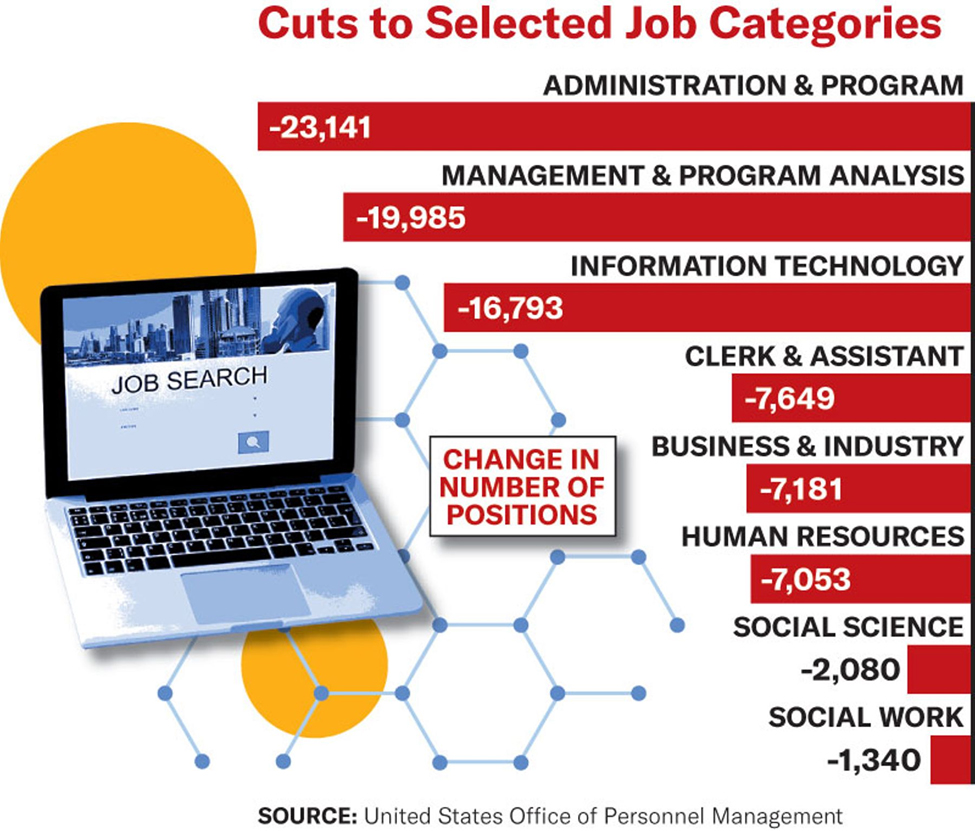
Looking beyond departments to the types of jobs eliminated, the biggest group by far, at over 43,000, consisted of general administration, management, and “program analysis” positions—the sorts of middle-management jobs that previous government-slimming efforts have targeted. Other positions that saw large cutbacks included general attorneys, HR officials, clerks, and general business managers, each losing roughly 7,000 workers. If you wanted to trim fat, these are the positions you’d start with.
DOGE also made smaller cutbacks across hundreds of types of federal positions, adding up to significant numbers. The government has eliminated 1,000 or more positions among public-affairs specialists, logistics managers, financial administrators, accountants, budget analysts, social-science analysts, and grants managers. It also lost about 100 interior designers and creative-arts therapists.
Two surprising areas of shrinkage were information technology (17,000 fewer positions) and contracting (slightly fewer than 7,000). The administration has emphasized reforming these areas, so some of these reductions may prove temporary, aimed more at replacing personnel than at permanently slimming the workforce.
The DOGE civil-service cuts were substantial, but they fell heavily on administrative and managerial jobs across a wide range of agencies. Those who decry them need to explain why, for instance, the roughly 160,000 administration, management, and program-analysis positions that remain are insufficient—and how having tens of thousands more such government workers would improve the lives of Americans.
In previous periods of workforce reform, the government has sometimes replaced civil servants with contractors doing similar work. That does not appear to have happened with DOGE.
The government’s massive procurement complex uses so-called Product and Service Codes to classify its yearly purchases. Focusing on Professional, Administrative, and Management Support services (the closest contractual equivalent to much of the work performed by civil servants), the Trump administration spent $100 billion on such contracts over the year ending in June—a not-insubstantial drop from the $112 billion shelled out during the Biden administration’s last year. Broaden the categories to include IT services, training, analysis, and operation of government facilities—other work that approximates civil-service functions—and one sees a similar, though smaller, decline, from about $226 billion to $218 billion.
By any reasonable measure, then, the eliminated civil-service positions were not simply replaced by contractors. In fact, government-service contracting declined, too.
DOGE claimed that it cut tens of billions in contracts across all aspects of federal operations. At DOGE’s “Wall of Receipts,” which documents supposed savings, contract cancellations are the biggest part by far. Looking at all government contracts, including those unrelated to typical civil-service work, total spending did rise during the most recent year under Trump, relative to the final year of the Biden administration. But most of that increase came from the buildup in homeland-security and defense contracting, including purchases such as surveillance aircraft and tanks, rather than substitutes for government workers. DOGE achieved real contract savings, but these were more than offset by higher spending elsewhere, reflecting a shift in priorities rather than an overall reduction in contracting.
One of DOGE’s other major emphases was slashing grants, which, it noted, often went to left-leaning nonprofits and universities with little accountability. In the year ending in June, the government spent $226 billion on project grants and cooperative agreements, the types of grants over which the administration has the most discretion. Comparing that figure with the final months of the Biden administration would exaggerate the decline because of an unprecedented effort to push grant money out the door after the election but before Trump took office. One Biden official said that it was as though “we’re on the Titanic and we’re throwing gold bars off the edge.” In the last full year of the Biden administration before the election, the government spent $237 billion on such grants. Grants, then, saw a modest but noticeable decline.
In sum, Trump and DOGE made some cutbacks to contracts and grants while redirecting spending toward new priorities. But the savings here are likely to prove temporary: total spending in these areas is not materially different from what it was under the Biden administration. The workforce reforms are likelier to endure—and to remain DOGE’s most important legacy.
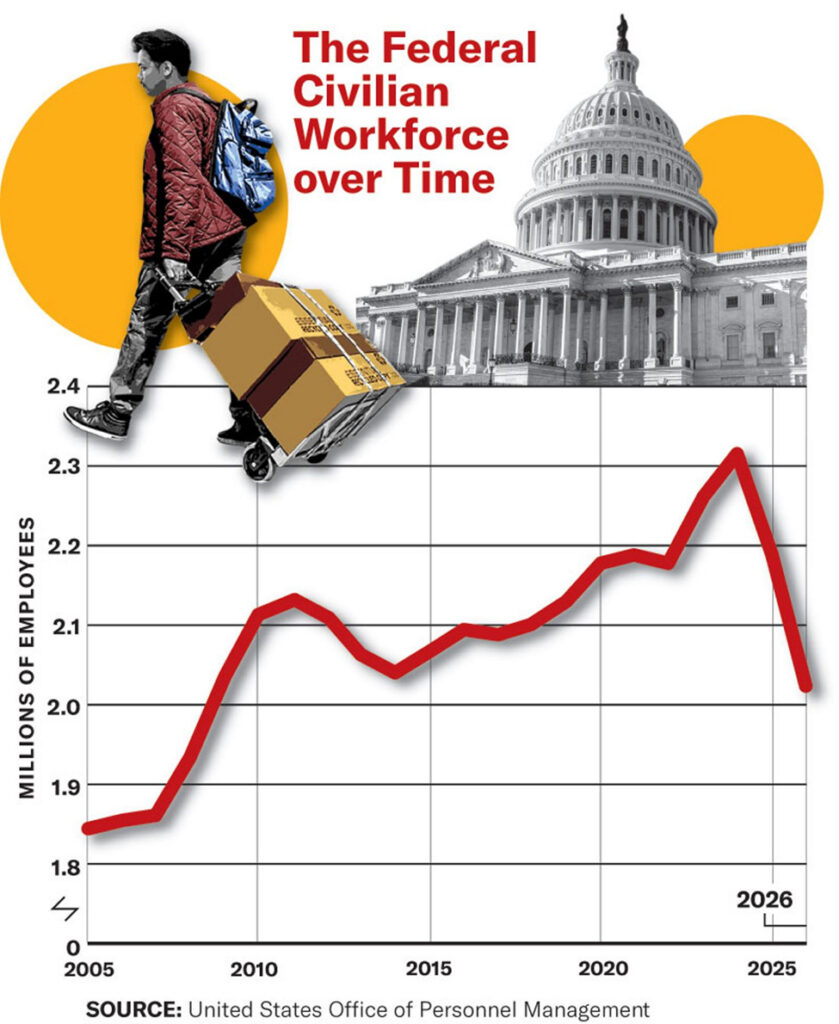
Only twice in the last century has the federal workforce shrunk on a comparable scale. The first came after World War II, when the federal government let go more than 1 million employees in two years. Yet since the workforce had swelled by more than 2 million during the war, this hardly represented an austerity program.
A closer analogy to Trump’s reforms is the retrenchment of the 1990s, an effort backed by both parties. Less than a month after taking office, President Bill Clinton issued an executive order calling for the elimination of 100,000 government jobs. Though some of the cuts reflected the post–Cold War “peace dividend,” Clinton directed every agency with more than 100 employees to “eliminate not less than 4 percent of its civilian personnel positions” over the next three fiscal years. The Federal Workforce Restructuring Act of 1994 accelerated the effort by authorizing buyouts for federal employees.
Clinton was able to push these changes through, despite typical Democratic support for the civil service, because he was willing to get rid of middle-management positions that had little outside support. One of Clinton’s reformers, John Kamensky, said that the unions acquiesced because they supported reducing the ranks and power of middle managers. The retrenchment took place over five years, but by its end, the federal workforce was 400,000 employees smaller. There was little indication that government became less efficient as a result.
Under both Clinton and Trump, most of the reductions came through resignations or retirements. Under Trump, however, workers faced far more pressure to leave. Some of DOGE’s efforts were ham-handed and seemed designed to make life harder for those who remained. One Brookings Institution analysis found that there were more than 25,000 instances where someone was fired, but was then hired back. The fight against telework was so extensive that the federal government ended up with a lower work-from-home rate than the private sector—an unusual disparity, given its disproportionately white-collar workforce, and one that could eventually make recruitment and retention harder.
One reason for the often roundabout efforts to downsize the workforce is the stultified nature of America’s civil service, which makes targeted reductions difficult, as the original Musk and Ramaswamy op-ed observed. But that some changes were reversed, or will be reversed, does not mean that the broader project was misguided. Musk admitted after he slashed the Twitter workforce by 80 percent that some people would have to be rehired. Likewise, the reversal of some federal cuts suggests that the administration was willing to recognize where civil servants performed important work and adjust accordingly. The best measure of whether the reductions worked is how they affected—or didn’t affect—ordinary Americans.
Since the advent of DOGE, opponents have predicted dire consequences from the loss of federal employees. Everett Kelley, president of the American Federation of Government Employees, warned that the reductions would “have vast, unintended consequences that will cause chaos” for Americans.
The media have hunted for such catastrophic consequences ever since. When flash floods killed more than 100 people in Texas over the July 4 weekend in 2025, some claimed that cuts to the National Weather Service had led to delayed warnings. Yet even former NWS staffers noted that the agency had issued an urgent warning hours before the flooding and had performed as expected. The NWS pointed out that five staffers were on duty in the region, typical for an overnight shift when severe weather was expected. Any connection between the deaths and the slimmed workforce was tenuous, at best.
The Internal Revenue Service saw the largest rollback of any government “subagency,” losing about 27,000 employees, or more than a fourth of its headcount. Many predicted that this could lead to billions of dollars in lost tax revenue. Yet the reductions largely reversed the staffing increases from the Biden administration, returning the agency to roughly the employment levels of Trump’s first term. The total additional tax recommended from audits did decline in fiscal year 2025, down $2 billion to $27 billion. But that figure was also broadly in line with levels at the beginning of the Biden administration, while the total tax take rose substantially. Reduced IRS staffing may ultimately hamper the agency’s ability to collect taxes, but so far, little evidence supports the massive revenue losses that critics predicted.
The Social Security Administration endured the next-largest workforce reduction of any agency. Martin O’Malley, who headed the SSA during the Biden administration, predicted disaster. “You’re going to see the system collapse and an interruption of benefits. I believe you will see that within the next 30 to 90 days.” He told seniors to “start saving” in preparation. When O’Malley issued his warning, the administration planned to eliminate 7,000 positions; it has now gotten rid of 8,000.
The subsequent debate over the SSA’s performance has not been about any interruption in benefits, which never occurred, but about whether call wait times went up or down slightly. Frank Bisignano, a former fintech CEO who now heads both the IRS and the SSA, claimed that wait times had declined. Senator Elizabeth Warren claimed that the agency was concealing an increase. An audit that Warren requested from SSA Inspector General Michelle Anderson, a longtime civil servant, found that the agency saw a 65 percent increase in calls over the previous year, while average wait times fell. The audit concluded that the agency had “improved performance because it used a new telecommunications platform and staff realignments.” In any case, a debate over wait-time minutes was a far cry from predictions of hungry seniors. (By contrast, the IRS wait time for its main help line did increase in this period, from about four to seven minutes, one study found.)
The federal government publishes a vast array of statistics on everything from the economy to personal health. At the outset of the second Trump administration, some data librarians panicked about DOGE or other cuts to statistical agencies and created a “Data Rescue Project” to preserve information that the Trump administration might ax.
Today, the dataindex.us website finds 38 datasets or groups of datasets that have stopped publication since Trump’s inauguration. While some discontinued reports—on wages in particular industries, say—may have broad uses, the value of others is less obvious. The government no longer publishes an annual count of mink pelts produced or an interactive map projecting (guessing, actually) how much climate change might cost each U.S. county. And gone, too, is a consumer complaint database about financial companies. Perhaps the administration concluded that American consumers already have plenty of outlets for complaining online.
Dataindex.us also notes 338 instances of “data elements removed” from other datasets, which sounds worrisome until one sees that the overwhelming majority involved ending the collection of information about “gender identity.” Given the roughly 550,000 government datasets, these changes seem minor.
When lettuce contamination led to a cyclospora outbreak that hospitalized hundreds this year, the New York Times wanted to tell its readers that Trump’s data-gathering reductions hampered the search for the source. But the paper could say only, in painfully roundabout language, that “funding cuts haven’t made the job easier.” It also acknowledged that most experts considered the investigation “par for the course” and that, while the CDC had scaled back a specific foodborne-illness tracker, “states still test for and report the infections to the CDC through other routes.”
No DOGE intervention garnered as much attention as the dismantling of the U.S. Agency for International Development. USAID saw the largest proportional workforce reduction of any agency: more than 90 percent. Atul Gawande, a former USAID official in the Biden administration, repeated charges that, even before the first year of the Trump administration was over, USAID cuts had already caused 600,000 deaths, most of them children. The Lancet claimed that, with continuing cuts, 14 million additional deaths could happen by 2030.
Yet those dire estimates are difficult to square with the government’s own spending figures. The United States provided almost $9 billion in health aid in fiscal year 2025. That was down from $13 billion in the last full year of the Biden administration, but not far below the $10 billion provided in 2023 and roughly equal to the nearly $9 billion provided in 2019, during Trump’s first term. And in the national security and State Department appropriations act for fiscal year 2026, signed by President Trump earlier this year, Congress provided $9.4 billion for global health.
A broader view of foreign aid, including health, humanitarian assistance, and other program support, shows a more substantial drop from the Biden administration’s final totals—almost by half, to $18 billion. But that figure is, again, not far below the $22 billion given in 2019. Even after accounting for inflation, the government spent billions more on such aid last year than in 2006, during the George W. Bush administration.
Many people confused two kinds of cuts: those to USAID’s workforce and those to foreign aid itself. The former were far more severe than the latter. With fewer USAID workers, the Trump administration has changed how foreign-aid funds are distributed. It spent billions to quadruple the budget of a UN humanitarian-affairs fund and provided billions more through bilateral agreements with foreign governments, rather than relying on traditional distribution channels such as nonprofits. Disbursals have slowed, even from newly appropriated funds, but the administration has focused the money it has distributed on paying health workers and buying medications. By contrast, it has slashed funding for programs such as workforce training. It’s far too soon to know the effects of the new system.
One can make a good argument that health aid has brought enormous gains in well-being to some of the world’s most desperate people, and that more is needed. But charges about deaths resulting from USAID cuts were often based on confusion about what actually happened. Much of the aid still went out the door. Claims of mass deaths also overlook that, by the same logic, one could accuse previous presidents of causing millions of deaths by declining to spend even more.
Cuts to the IRS and foreign aid have less to do with efficiency, DOGE’s putative focus, than with competing policy priorities. Republicans have long worried about excessive IRS intrusiveness, even if greater enforcement raises more revenue, and have argued that American taxpayers should not be overly burdened with supporting people abroad. Unlike many other DOGE reductions, those at the IRS and USAID can’t be evaluated by a simple measure of efficiency. Whether they “worked” depends largely on what one believes the goals of government should be.
Most of the workforce reductions, however, came in traditional government agencies, from the Department of War to the Department of Transportation to the SSA. Despite the fervent fears (or hopes) of critics, there is little evidence that the reforms kneecapped the agencies’ operations.
The DOGE cuts were never going to restore the federal government to fiscal solvency. Federal spending overwhelmingly goes to mandatory programs, especially entitlements, that DOGE could not touch.
Yet many in the media, while claiming that DOGE had devastated the government and even killed millions, also argued that its cuts saved zero money. They pointed to charts showing federal spending rising in 2025 relative to 2024. Such comparisons ignored the continued growth of entitlement spending and interest on the debt, both largely outside DOGE’s reach, as well as the fact that many savings from workforce cutbacks and contract cancellations would take time to materialize.
Some argued against the civil-service cuts by pointing out that the federal workforce accounts for only a small share of federal spending. Spending on federal employees constitutes less than $400 billion, or about 5.5 percent of federal expenditures.
Yet the federal government is so big that cuts to almost anything can be dismissed as minor. Outside Washington, $400 billion still counts as a lot of money, and saving even a fraction of that amount year after year can make a material difference. The Economic Policy Innovation Center estimated that shrinking the federal workforce by 10 percent would save about $600 billion in salaries and health benefits over about a decade. More savings would eventually come from reduced pension liabilities. The Trump administration’s workforce reductions could produce even greater savings.
DOGE’s argument, shared by Office of Management and Budget director Russ Vought, was that there was plenty of fat in government, even at agencies that Republicans favored. After all, about 1.3 million of the government’s roughly 2 million workers are employed by the Departments of War, Veterans Affairs, and Homeland Security. DOGE and Vought argued that most agencies could do more with less. The evidence so far suggests that they were right.
Many of DOGE’s claims were exaggerated, in part because of Musk’s typical exuberance. Trump famously described him as “50 percent genius, 50 percent boy.” But if one stops comparing DOGE with its promises and considers its actual effects, its record looks quite different. In about a year and a half, the federal workforce shrank by more than a tenth, while targeted grants and contracts declined as well. The government kept functioning much as before. One might call that a success.
Judge Glock is director of research, a senior fellow at the Manhattan Institute, and a contributing editor of City Journal.
ADVERTISE HERE!
To advertise online or in a printed edition of the Texas Conservative Review, please contact Marc Cowart at 832-282-2175 or email [email protected]
ADDITIONS, CORRECTIONS OR FEEDBACK?
E-mail Marc Cowart at [email protected]
ABOUT YOUR EDITOR
Gary Polland is a long-time conservative and Republican spokesman, fund-raiser, and leader who served three terms as the Harris County Republican Chairman. During his three terms, Gary was described as “the most successful county Chairman in America” by Human Events – The National Conservative Weekly. He is in his twenty-eighth year of editing a newsletter dealing with key conservative and Republican issues. For the last twenty-three years, he has edited the Texas Conservative Review. As a public service for the previous 20 years, Gary has published election guides for the GOP primary, general elections, and city elections, all to assist conservative candidates. Gary also for 20 years cohosted Red, White and Blue on Houston Public Media TV 8 PBS Houston, longest running political talk show in Texas history and for the last four-plus years Gary has been a regular commentator on Fox 26-Houston’s “What’s Your Point” airing Sunday’s at 7 a.m. Gary serves on the Board of Directors of American Values, a national pro-family, pro-faith, conservative organization supporting the unity of the American people around the vision of our founding fathers and dedicated to reminding the public of the conservative principles fundamental to the survival of our nation. Gary is a practicing attorney and strategic consultant. He can be reached at (713) 621-6335.


